
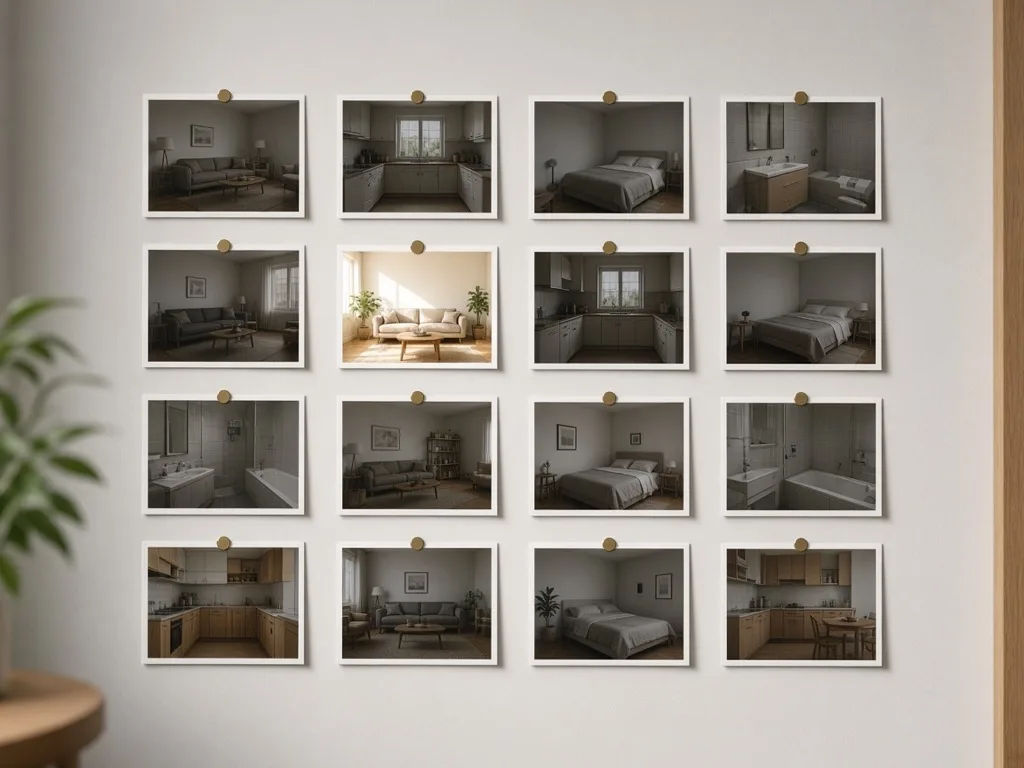
Prospective buyers choose from the list of adverts based on a single preview photo and make their decision in a matter of seconds. We’ve looked at what can be substantiated by sources regarding the impact of photographs, what cannot be substantiated, and where the line is that a retouched photograph must not cross.
MeaReal (meareal.com) is a Slovak service for editing property photographs, operated by MeaOvis s. r. o. It operates on a credit-based model: one credit equals one edited photograph, whilst the premium PRO edit costs two credits. It offers seven types of property photo edits and also adds the advert text to the photographs. It is designed for estate agents and estate agencies.
The first filter is a preview, not a property
According to a survey by the National Association of Realtors, buyers who used the internet to search for a home rated photographs (81 per cent), detailed property information (77 per cent), floor plans (57 per cent), the estate agent’s contact details (44 per cent) and virtual viewings (38 per cent). Photographs came top of the list (NAR, 2025 Profile of Home Buyers and Sellers). In another survey by the same association, 88 per cent of estate agents representing sellers and 73 per cent of those representing buyers rated photographs as highly important to clients, which is more than physical home staging or video (NAR, 2025 Profile of Home Staging).
This is US data and respondents’ answers, not transaction-based measurements. We have not found any reliable figures for the Slovak property market regarding the impact of photographs on price or the time taken to sell a property. Anyone who uses percentages to argue this point is relying on data from elsewhere.
What happens when a photo is poor quality
An analysis by Zillow of property listings from late 2014 found that a property with fewer than nine photographs is approximately 20 per cent less likely to sell within 60 days than a property with 22 to 27 photographs. A listing with fewer than 100 views in the first week had an approximately 12 per cent chance of selling within 60 days, whilst a listing with 280 or more views had an approximately 36 per cent chance. These are US national averages (Zillow Research).
In the same text, Zillow itself points out that this is a matter of correlation, not causation, and that such indicators are skewed by self-selection. Those who pay for professional photographs generally also have different properties, are in different locations and have different levels of experience. Zillow does not claim anywhere that the number of views is determined by the quality of the photograph.
The best-documented figure in this area comes from academic research into short-term lettings. Professional photographs increased property occupancy by approximately 9 per cent, which, for the average property in the data, translated to approximately 19.5 additional occupied days per year (Zhang, Lee, Singh, Srinivasan, Management Science 68(8), 2022, methodology in a CMU dissertation). There are significant caveats: the treatment group comprised only 221 properties; these were Airbnb listings in seven US cities, not sales; and the photographs were taken by Airbnb professionals, so the effect is attributable to both the photographer and a standardised procedure.
The same study also demonstrates the mechanism. When the authors added 12 measurable image characteristics to the model, the ‘professional photograph’ effect ceased to be statistically significant. One of the attributes, brightness contrast, assesses precisely whether the lighting is evenly distributed across the entire image, and the authors state that sufficiently and evenly lit photographs lead to higher demand. Some of these parameters, particularly hue, saturation and brightness, can be adjusted even after the photograph has been taken. Post-production does not alter the composition or the relationship between the subject and the background; these are determined by the photographer.
Taken together, these two studies point to one practical conclusion for property adverts, and it is not ‘hire a professional photographer’. Zillow measures the number of photographs and views, whilst Zhang and his team have found that the ‘professional effect’ disappears when measurable image characteristics are incorporated into the model. This means that most of the difference is not down to more expensive equipment, but to factors that can be measured and corrected after the shot has been taken: even lighting, tones and saturation. What post-production cannot fix is the composition, the angle of the shot, and the fact that there is only one room in the photo, whilst buyers want to see twenty.
MeaReal updates and what each one does
MeaReal handles four types of transactions for each type of property:
- Basic photo editing. It straightens the horizon and vertical lines after shooting handheld, adjusts contrast and sharpness, reduces noise, and standardises colours across the entire set. It addresses situations where photos were taken on different days and with different mobile phones.
- PRO: premium editing for two credits. The only edit that costs two credits instead of one. It straightens verticals and the horizon, combines the full tonal range as a merged exposure, adjusts contrast and colours, and, for interiors, opens the window so that the view through the glass is clear; lights that are actually in the room are switched on. Outdoors, it also optimises the sky. The output is at double the resolution. It is the photo processing and the environment that change, not the property itself: cracks, damp patches and wear and tear remain just as visible. Only in the PRO version can you also change the season and time of day, and add your own editing instructions for one extra credit.
- Light Balancing. This evens out the light distribution, removes any yellow or blue cast from the light bulb, and brings out details in dark areas. This adjustment corresponds to the ‘brightness contrast’ mentioned in the academic research cited above.
- Clearing up clutter. Removes items from the photograph that do not form part of the property: a clothes horse, cosmetics, magnets, cardboard boxes, a hose in the garden, empty pallets.
- Clearing up the surroundings. The same thing, but from the outside. From the view of the house, anything that does not belong there and spoils the shot is removed: skips, wire fencing, building materials, unauthorised parked cars, a pole and wires crossing the shot, and clutter on the neighbouring plot. The location remains the same; the neighbouring houses, the landscape and the sky do not change. A damaged or rusty fence remains: this is no longer a mess, but a feature of the property.
Three of them apply only to property:
- Clearing the room. The furniture is removed so that the layout and dimensions are clearly visible. This is done selectively, not throughout the entire building.
- Virtual home staging. It adds furniture to an empty space to give the prospective buyer a sense of scale. It is a visualisation and must be labelled as such.
- A clean floor plan. For a drawing from the developer, which the estate agent only has on paper. It turns a photograph or scan into a legible plan: it corrects the perspective as if the paper had been scanned, removes the table underneath it, fingers, the shadow of a mobile phone, glare and the dark strip in the crease, and brightens the paper. Dimensions, numbers, room names, scale and legend remain unchanged. This is the only adjustment in the service that does not go through the AI model, and the reason for this is explained below.
Five typical situations
The following situations are illustrative. They do not refer to specific clients or case studies; rather, they describe the types of projects that are common on the Slovak market.
My parents’ flat and a mobile phone instead of a photographer
An independent estate agent in Košice takes on three to five properties a month, mostly older flats in prefabricated blocks of flats. At this price point, he can’t afford to pay a professional photographer, so he takes photos with his mobile in the early evening when he gets hold of the keys. The flats are furnished with dark furniture, with the curtains drawn and a single light bulb in the centre of the ceiling, and the heirs do not clear them out for several weeks. Procedure: living areas to be brightened up; kitchen and bathroom to have clutter cleared away; hallway and exterior to get basic editing; the largest room to be cleared out and staged to demonstrate its potential. The fees can be calculated in advance and compared with the commission.
The photographer isn’t available until Friday, but the advert must be online by Wednesday
The Bratislava office, with six estate agents, has a contracted photographer whom they do not wish to let go. The problem is not the quality of his work, but the timing of publication: property portals rank listings by recency and send notifications for saved searches. The solution involves two tiers. The ‘fast’ tier is on the day of signing: the estate agent photographs the flat with their mobile phone following a brief internal procedure, the images are edited, and the advert goes online on the same day. The ‘planned’ tier is reserved for the photographer to handle more expensive properties, houses and video viewings. The third element is not technology, but a written internal agreement specifying which edits are to be used and what should be included in the description.
An empty flat in a new-build development which the prospective buyer is unable to furnish
A standard flat, unfurnished, photographed between two viewings. In the listing, it appears alongside flats in the same development that are already furnished. An empty room gives no sense of scale; the gallery blends into a series of white walls, and the photographs cannot be matched to the floor plan. Procedure: basic editing and brightening of the entire set, removal of construction debris and protective films, staging of the living room and bedrooms in a single furniture style throughout the flat. For each photograph featuring virtual furniture, the original version of the empty room must also be included in the gallery, and the text must distinguish between what is included as standard and what the buyer will have to provide themselves.
A house that looks better on the inside than on the outside
The interior has been refurbished, but the courtyard is still just a courtyard: a bin, a pallet with paving slabs, a hose, the neighbour’s car by the fence. Prospective buyers see precisely this courtyard in the preview, as the main photograph of the house is usually an exterior view. Process: clearing the surroundings in the exterior shots, basic colour correction to unify the tone across the entire set, and brightening the interiors near the window. What remains: a damaged fence, cracks in the plaster and damp patches, as these are no longer simply clutter but part of the property’s condition. Detailed photographs of defects belong in the gallery and are not edited.
For sale by owner: the price is fine, but the first photo is a problem
The owner of a three-bedroom flat is selling it himself; he has based the price on similar listings in the neighbourhood, but the advert has been up for weeks and the phone hasn’t rang. He puts it down to the market, whilst the main photo shows a dark living room with a clothes horse in the frame, taken against the window. Procedure: remove any photos that don’t provide useful information; send the rest for brightening, basic editing and clutter removal; focus the clearing-out process on one or two of the most cluttered rooms; and choose the main photo based on how it looks in the small preview.
In none of these situations does the photograph determine whether a sale goes through. It is the price, location and condition that matter. The photograph determines whether the listing even reaches the right buyer.
Where does honesty end?
Home improvements may alter the appearance of a property. They must not alter what the buyer finds during a viewing. Defects and the technical condition of the property - such as damp, mould, cracks, a leaking ceiling, damaged flooring or old wiring - must not be concealed. The layout, dimensions, and the number and position of windows and doors must not be altered. The view from the window must not be altered. Fixtures and fittings that are not present in the property - such as a new kitchen unit or fitted wardrobes - must not be added.
There is also a well-documented argument against exaggerated presentation. The same authors who measured the impact of professional photographs later published a study on why medium-quality photographs may have a better long-term effect: a high-quality photograph will increase demand in the short term, but if the reality fails to live up to expectations, the customer will write a bad review or none at all, and this will damage future demand (Zhang, Mehta, Singh, Srinivasan, 2023, SSRN). In a property survey, 58 per cent of estate agents stated that buyers were disappointed by how the houses looked in person, and 77 per cent said that television programmes create unrealistic expectations (NAR, 2025 Profile of Home Staging).
A rule is only a rule if it answers four practical questions.
Where and how the visualisation should be labelled. In the description of the specific photograph, not in the final paragraph of the advert. When staging, use wording such as: ‘Visualisation; virtual furnishings; furniture is not included in the sale’. When the property is unfurnished: ‘Visualisation; the furniture has been removed from the photograph but is present in the property’. California law requires that the statement be sufficiently clear and placed on the image or directly next to it, together with a link to the publicly available original (California AB 723). One US MLS implements this by requiring that the unedited original must appear in the gallery immediately before or after the edited version (CRMLS Knowledgebase).
Who adds the label? The person publishing the advert - that is, the estate agent, estate agency or seller. The Californian requirement applies to licensed estate agents, not to portals that distribute the adverts (HousingWire). The editing provider may prepare the label, but it is up to the advertiser to publish it.
How long to keep the original. An unedited photograph should be available for the entire duration of the advert and archived even after the transaction has been completed, in case of a dispute regarding the claims made in the advert. An analysis of nearly 40,000 main photographs from US property portals found signs of digital editing in 10.8 per cent of them, and more than 90 per cent of the edited images lacked a visible label; the analysis cites a workflow issue as the cause: the estate agent receives a file from the photographer without metadata, and the originals remain with the photographer (HousingWire, analysis by Corala). There is also the opposite risk. In New South Wales, a photograph of a flat was labelled an AI fake because it showed a distant beach; in reality, it was a painting on a courtyard wall (The Cool Down). Providing the original also protects the advertiser.
Who is responsible for the advertisement? The advertiser. In Slovakia, there is no specific rule regarding the labelling of edited property photographs; but a general prohibition on unfair commercial practices applies, including misleading actions and misleading omissions (Act No. 108/2024 Coll. on Consumer Protection). The fact that unlabelled editing which conceals the actual condition may fall within this definition is a legal judgement, not a quotation from the Act. The ZRKS Code of Ethics requires members to include only truthful information and photographs in their adverts (ZRKS Code of Ethics). The terms and conditions of the Nehnuteľnosti.sk portal prohibit inaccurate and ambiguous information, as well as photographs where it is not possible to unambiguously identify the subject of the advertisement (Terms and Conditions of Service). In addition, from 2 August 2026, Article 50 of the EU Act on Artificial Intelligence will apply, under which synthetic content must be labelled in a machine-readable format and deepfake content must be clearly and distinguishably labelled at the latest upon its first publication, whilst standard edits such as filters or colour correction do not fall under this obligation (European Commission FAQ). Whether standard virtual staging falls into the category of deepfakes is not made clear in the FAQ.
Season and time of day: where does photo editing end?
In PRO mode, you can select the season (spring, summer, autumn, winter) and the time of day (morning, late morning, midday, afternoon, early evening, evening, night, early morning). A house photographed on a cloudy summer’s day can thus look as though it were an autumn morning or early evening, with lights on in the windows. This is what is known in estate agency photography as a ‘twilight shot’, and is something commonly offered by overseas suppliers as well.
The only things that change are those that actually change at that moment: the sky, the colour and direction of the light, the length of the shadows, the condition of the greenery, and whether the lamps that are actually present in the scene are lit. The location, the angle of the shot, the building and its actual condition all remain the same. Nothing is added and nothing is removed.
However, we must call a spade a spade: this is the only form of editing that deliberately alters reality, rather than merely processing a photograph. A house photographed in winter but shown as if it were summer is a different representation from a house photographed in winter. The same applies to property as to virtual home staging: it is a visualisation and must be labelled as such in the advert. That is why changing the season or time of day is intentionally restricted to the PRO version, and other editing options do not allow it; the basic editing and lighting tools both state in their instructions that the weather or time of day must not be altered.
Where we don’t let the model have the last word: the numbers on the floor plan
The limits of integrity are not just about what we forbid the model to do. In some cases, the answer is simply that we do not let it have a say at all. The floor plan is precisely such a case, and this is not a matter of opinion, but the result of a test.
The instructions were clear: straighten and clean the paper, but do not redraw anything, do not rewrite anything, and leave anything that is illegible as it is. The same photograph of the paper drawing was used in the model five times, in two different resolutions. The result looked flawless every time: a flat sheet, white paper, sharp lines. And each time, at least one dimension was different from how it had been printed. 5,680 became 5,690 three times, 5,660 once, and 5,690 with an extra digit once. In one trial, 3,950 became 3,960; in another, 1,730 became 1,720. On two occasions, the space in the thousands place changed to a decimal point, so that 3,950 millimetres suddenly became 3.950 metres.
The room names, areas, scale and key survived all five attempts without a single error. It was the dimensions that failed: small, rotated by ninety degrees, at the edge of the paper, one of them obscured by the line of the balcony. The model was unable to read it, so instead of leaving it as it was, it wrote the number that fitted there. This is exactly what image-based models do with text: they do not scan it, they redraw it.
With a room, such an error is obvious at first glance. With dimensions, it isn’t. No one will spot a one-centimetre difference in the width of a room on a drawing, yet an estate agent will pass it on and vouch for it. That is why floor plans in MeaRealy are calculated, not generated. The programme identifies a sheet of paper in a photograph, projects it onto a plane, estimates the brightness of the paper itself at that point, and divides the image accordingly, thereby removing both shadows and creases. Every line and every number remains the same pixels, merely straightened and cleaned up. They may be blurred, but they cannot be anything else.
This has two obvious consequences. When the paper in a photograph cannot be distinguished from the background - for example, a white drawing on a white table - the perspective is not corrected and only the light and contrast are adjusted; a crooked floor plan is better than one with dimensions cropped out. And illegible data remains illegible, because a made-up dimension is worse than none at all.
Case 3: brands that showcase their own products
An estate agent takes a photograph of someone else’s property and wants to show it as it really is. A manufacturer or retailer takes a photograph of the same room for the opposite reason: to showcase their products in it. A curtain manufacturer receives a photograph of a customer’s window and needs to send back an image showing how a specific fabric would look on it. The same applies to kitchen design studios, and retailers of flooring, furniture or garage doors. This is a different task from any of the standard editing tasks, and none of them can cover it.
For such cases, MeaReal offers bespoke tags. A tag is a customer who receives customised settings: each has its own description tailored to their product range and its own price in credits. They are visible only to the account to which the brand is assigned; they do not appear in the menu for others, and the server will reject them even if someone sends them directly.
The first customer of this kind is InGlory in Bratislava, a family-run business that makes bespoke curtains and drapes and handles orders from the initial measurements right through to installation. Its product range is precisely the sort of case where a static photograph from a catalogue is not enough: airy voile and heavy blackout curtains look different in every room, depending on the type of window, how much light there is in the room and what colours are already present.
Three options are available for InGlory, each reflecting its product range: airy voile curtains stretched across the entire window, which let light through whilst preventing people from seeing inside; blackout curtains drawn to the sides; and both layers together. The customer sends a photograph of their window and receives back an image showing what each fabric would look like on it. The result is a visualisation, and that is how it is described; the actual dimensions, material and final appearance are only determined once measurements have been taken at the customer’s premises.
The same rules apply here as for staging, and they cannot be omitted from the brief: the room remains exactly as it is. Nothing is tidied away, nothing is removed, neither the perspective nor the lighting is altered, and the actual condition of the space, including any signs of wear and tear, remains visible. The only thing added is the product itself, to the correct scale, with shadows and reflections based on the light that is actually present in the room.
And the key point from the previous chapter still applies: this is a visualisation, not a photograph of the finished product, and it should be labelled as such. It shows what the product might look like. The design, bespoke manufacture, installation and final appearance remain the responsibility of the supplier, and no visualisation can replace them.
Making a call from your own website instead of the dashboard
A brand does not need to access the dashboard. It is provided with a key to the REST API and calls it directly from its website or online shop: it sends a photo and the editing code, and receives the finished image in return. This typically takes between 12 and 25 seconds. The key is linked to a single brand and a single account, so it can only initiate edits for that brand, and the credits are deducted from that account’s balance.
Practical details have been taken into account: photos can be uploaded as files or in Base64; JPG, PNG and WEBP formats up to 40 MB are accepted, and there is a limit of 20 calls per minute. If the connection is lost whilst the image is being generated, simply repeat the same request using the same idempotence key; the finished result will be returned and credits will not be deducted a second time. A failed edit is not charged at all; credits are automatically refunded.
How much does it cost and how does it work?
MeaReal operates on a credit-based model: one credit equals one edited photograph, whilst a PRO premium edit costs two credits. There is no monthly subscription and no flat fee per property. With three jobs a month, this means that the cost can be calculated in advance and compared with the commission, which, according to the professional association (SORA), is 2 to 5 per cent of the sale price in Slovakia.
To put this into the context of the Slovak market: one local provider charges 30 euros per photograph for manual virtual staging, with delivery within 36 hours at the latest (virtualstaging.sk), whilst another quotes 30 euros for virtual staging and 40 euros for virtual reconstruction per photograph (Marketing Nehnutelností). Photography services for flats with Slovak providers start at around 70 to 95 euros, rising to 210 euros for larger properties including video (Marketing Nehnutelností, fotenie-nehnutelnosti.sk). AI edits are now also being offered by traditional photography studios; one offers a package of ten photographs with four AI transformations for 159 euros (Fotobrana). Physical home staging is a different service, involving the provision of real furniture for viewings, and the median price for a professional service in the US is $1,500 (NAR). It would not be fair to compare digital photo editing with physical staging as if they were equivalent.
Give it a go on one job
We won’t claim that a retouched photograph will increase a property’s selling price. No such data exists for the Slovak market, and international studies measure other factors: the number of photographs, tenancy occupancy rates, and click-through rates. What we can argue, however, is this: according to buyers, a photograph is the most important element of a property advert; property portals directly reward and monetise the number and quality of photographs; and some of what makes a photograph good can be altered even after it has been taken.
Give it a go on a single listing, whether it’s a flat, a house or commercial premises. Upload an existing set of photos to meareal.com, select an edit for each photo individually, and compare your listing with those in the same location or price range listed next to yours. If you start measuring the results of your own listings, you’ll have the first Slovak data on this topic - and none of us has access to that yet.
Sources used
- NAR, 2025 Profile of Home Buyers and Sellers: https://www.nar.realtor/magazine/real-estate-news/nar-2025-profile-of-home-buyers-sellers-reveals-market-extremes
- NAR, 2025 Profile of Home Staging (press release): https://www.nar.realtor/press-releases/nar-report-reveals-home-staging-boosts-sale-prices-and-reduces-time-on-market
- Zillow Research, ‘Searched It, Saw It, Bought It’: https://www.zillow.com/research/home-characteristics-time-on-market-9937/
- Zhang, Lee, Singh, Srinivasan, ‘What Makes a Good Image’ (Management Science 68/8, 2022; methodology in the CMU 2019 doctoral thesis): https://www.cmu.edu/sites/default/files/cmu-tepper-site-files/2025-06/2019-business-technologies-zhang-dissertation.pdf
- Zhang, Mehta, Singh, Srinivasan, ‘Do Lower-Quality Images Lead to Higher Demand on Airbnb’ (2023, SSRN 4588974): https://papers.ssrn.com/sol3/papers.cfm?abstract_id=4588974
- California Legislative Information, AB-723: https://leginfo.legislature.ca.gov/faces/billNavClient.xhtml?bill_id=202520260AB723
- CRMLS Knowledge Base, FAQs on the California Altered Image Law: https://kb.crmls.org/knowledgebase/californias-altered-image-law-ca-ab-723-faqs/
- HousingWire, Most AI-altered listings go undisclosed (Coraly analysis): https://www.housingwire.com/articles/most-ai-altered-listings-go-undisclosed-california-law-bans-it/
- The Cool Down: A property listing photo was flagged as having been doctored by AI: https://www.thecooldown.com/green-home/bondi-beach-rental-photo-misleading-ai/
- Act No. 108/2024 Coll. on Consumer Protection: https://www.zakonypreludi.sk/zz/2024-108
- ZRKS Code of Ethics: https://www.zrks.sk/dokumenty-zrks/kodex-zrks/
- Terms and Conditions for the Provision of Services on Nehnutelnosti.sk (PDF): https://s.aimg.sk/unitedclassifieds/css/data/nehnutelnosti.pdf
- European Commission, Transparency obligations under Article 50 of the AI Act (FAQ): https://digital-strategy.ec.europa.eu/en/faqs/transparency-obligations-under-article-50-ai-act
- SORA, Estate agent’s commission: https://www.sora.sk/provizia-realitnej-kancelarie
- virtualstaging.sk, Virtual staging: https://virtualstaging.sk/properties/virtual-staging/
- Property Marketing, price list: https://marketingnehnutelnosti.sk/cennik/
- fotenie-nehmutnosti.sk, price list: https://www.fotenie-nehnutelnosti.sk/cennik/
- Fotobrana, price list for estate agency services: https://fotobrana.sk/cennik-sluzby-pre-reality/